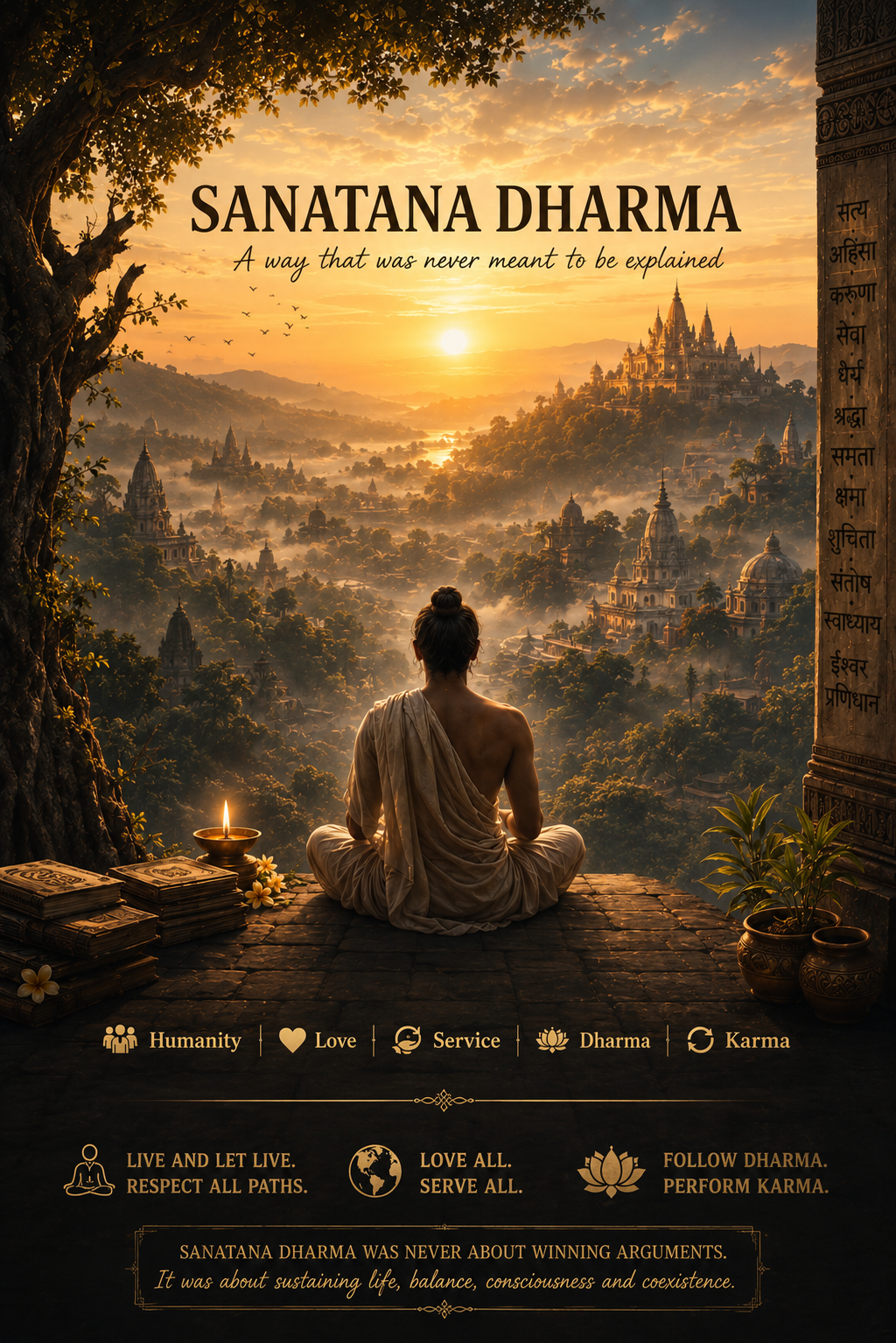
For thousands of years — perhaps over 4000 to 5000 years in recorded continuity, and even older in civilizational memory — Sanatana Dharma has existed on this land long before modern definitions, debates, hashtags, television panels, or intellectual frameworks tried to explain it.
And today, suddenly everyone wants to define it.
Think tanks.
Pseudo intellectuals.
Political narrators.
Social media warriors.
Even common people with half knowledge and full confidence.
But honestly, in my opinion, Sanatana Dharma was never something that could be completely “defined” inside a sentence or controlled by a single institution.
As far as I have understood and decoded it, Sanatana Dharma is simply a way of life.
People born on this Bharata land grew with this civilizational rhythm and called it Sanatana Dharma.
Those born in ancient Africa lived through their own tribal and ancestral spiritual systems.
Those in the Western world shaped philosophies rooted in Christianity and Greco-Roman thought.
Ancient Persia followed Zoroastrian traditions.
Ancient Egypt lived through their own sacred cosmology and spiritual practices.
Every civilization evolved with its own understanding of existence, duty, society, morality, nature, and the divine.
And Sanatana Dharma, in my opinion, was Bharat’s way of understanding life itself.
Nobody sat one day and wrote a rigid operational manual saying:
“Practice Dharma exactly like this.”
That is why Sanatana feels living, flowing, adaptable, and deeply personal.
At its core, what I understood is simple:
Live. Let live.
Respect life.
Follow dharma.
Perform karma consciously.
Coexist with humanity.
Yes, over centuries, interpretations changed.
People added convenience, comfort, politics, emotions, and personal agendas into it.
Different generations gave different definitions to suit their understanding.
But the essence always felt larger than arguments.
And one thing I have observed:
Those who truly practice rarely scream.
Those who constantly debate often reduce everything to perspective battles.
Because some things are meant to be lived before they are discussed.
In my opinion, Sanatana Dharma does not have a central executive authority constantly redefining it from time to time like a corporate policy document.
It survives through people, traditions, practices, values, stories, families, temples, philosophies, and lived experiences passed across generations.
Every individual who genuinely practices dharma becomes its representative in some way.
And perhaps that is why Sanatana cannot be fully controlled, standardized, or simplified into modern binaries.
My understanding is very simple:
If your actions knowingly break dharma, humanity, integrity, or karma — then you lose the moral right to lecture others about righteousness.
Before debating Sanatana Dharma, first learn how to live with humanity.
Love all.
Serve all.
Respect all.
And let people breathe peacefully within their own paths.
Because in the end, Sanatana Dharma was never about winning arguments.
It was about sustaining life, balance, consciousness, and coexistence across centuries.
And maybe the most honest way to understand Sanatana Dharma is this:
You do not truly understand it by debating it loudly.
You understand it quietly — through the way you live, treat people, carry responsibility, and walk through life with awareness.
– G.V.