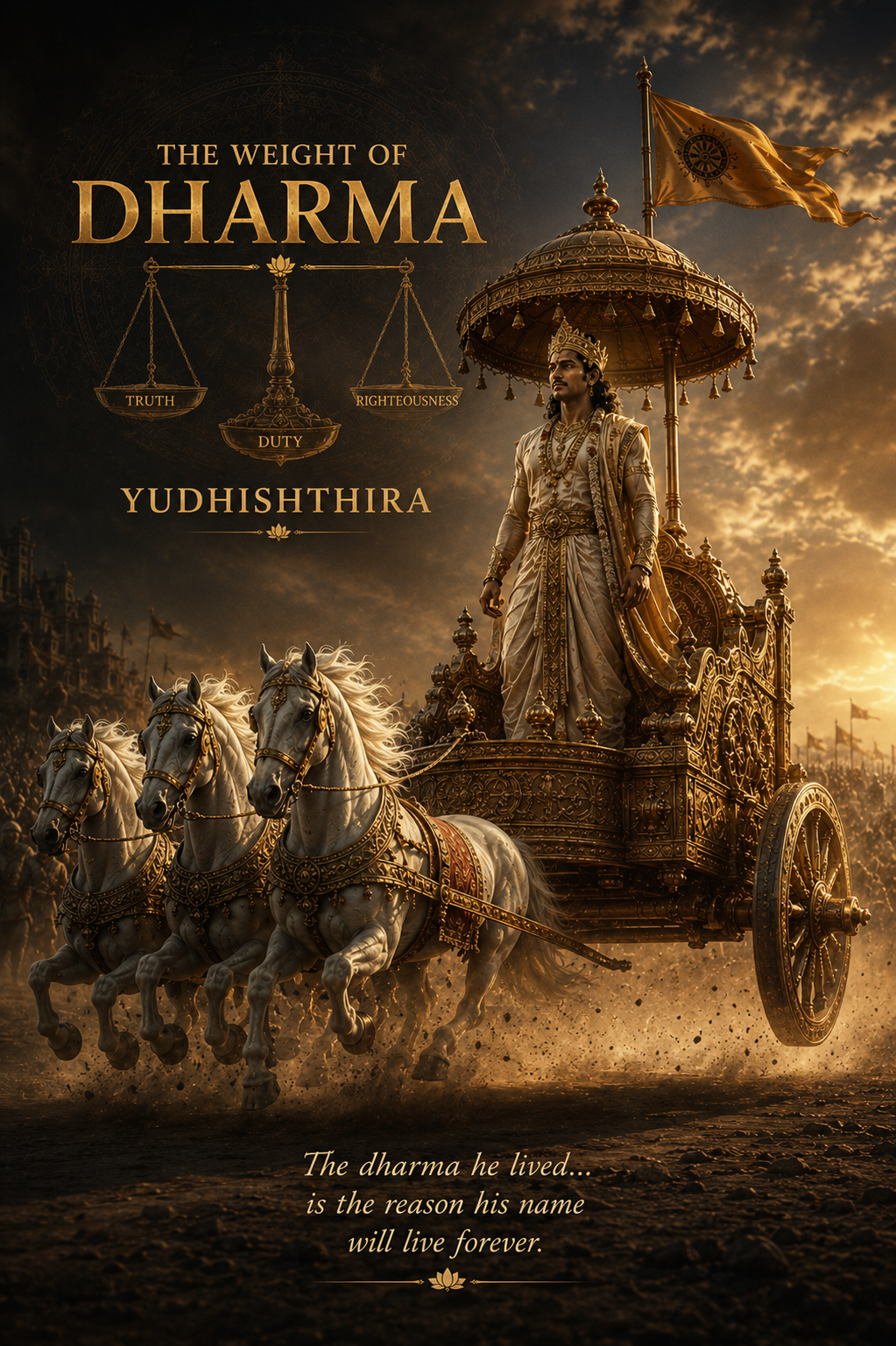
Among all the grand characters in Mahabharata, I always feel Yudhishthira is the most underappreciated soul.
There was no dramatic rage in him like Bhima, no unmatched archery like Arjuna, no divine charm like Krishna, nor the tragic rebellion of Karna.
He had no “mass” moments, no heroic adventures meant to glorify him before the world.
And maybe that is exactly why his greatness is often missed.
Because Yudhishthira was not written to entertain.
He was written to remind humanity what righteousness truly costs.
To be Yudhishthira is not difficult.
It is humanly impossible.
A man who lost his kingdom, his pride, his peace, and almost everything dear to him… yet never abandoned dharma.
Even when life pushed him into humiliation, exile, war, and unbearable grief, he never stepped outside the boundaries of righteousness for personal satisfaction.
What makes him sacred to me is not perfection — but restraint.
He was wise without arrogance.
Powerful without cruelty.
Knowledgeable without pride.
A king deeply rooted in rajaneeti, governance, diplomacy, justice, ethics, and the unbearable responsibility of duty — yet detached enough to accept both victory and suffering with the same calmness.
One small moment from Mahabharata always stays with me:
During the final journey to heaven, when everyone fell one by one, Yudhishthira alone kept walking with a stray dog beside him. And when he was asked to abandon the dog to enter heaven, he refused — because dharma, for him, was not convenience. It was character.
That is Yudhishthira.
A man who never practiced righteousness for recognition.
He simply could not live against his conscience.
Maybe that is why the Earth herself respected him.
It is said his chariot floated slightly above the ground — not because he conquered kingdoms, but because his honesty carried no weight of deceit.
And perhaps the greatest lesson he leaves behind is this:
Dharma does not always protect you from pain.
But it protects you from losing yourself while facing it.
– G.V.